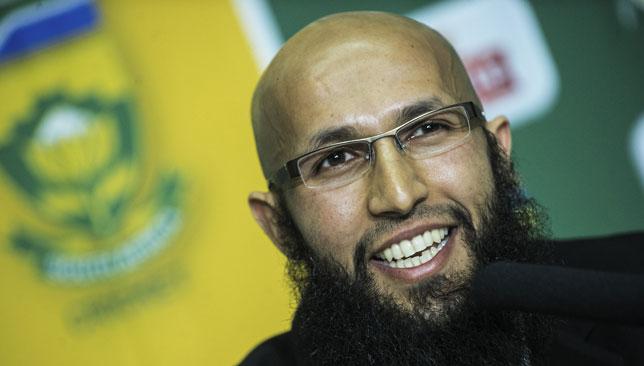
South Africa have made an interesting selection in Hashim Amla as their new Test captain ahead of other contenders AB de Villiers and Faf du Plessis.
Of the three, Amla was a reluctant captain having relinquished the one-day vice-captaincy last year, as he focused on improving his batting.
The 31-year-old entered the captaincy fray much later with de Villiers and du Plessis being the frontrunners and they were also quite vocal about their ambitions to lead following Graeme Smith’s retirement.
It was believed that de Villiers would get the reins of the Test team as he was seen as an ideal successor to Smith. The wicket-keeper batsman captains the one-day side and is a key player across all three formats.
Du Plessis, the youngest of the three contenders and the Twenty20 captain, believed if Smith could have been entrusted with the leadership at 22, he at 29 stood a good chance.
So what turned the tide in Amla’s favour? It is rumoured that in a race-conscious nation, selecting Amla of mixed origin as captain presented the best opportunity for Cricket South Africa to prove that the sport is serious about racial transformation.
I have my reservations on this theory. Because making it an issue of race will be doing huge injustice to the abilities of a fabulous cricketer.
What Amla brings to the table is impeccable character and world-class talent with the bat, as well as being someone who is held in high esteem by his teammates and opponents.
Not to forget that without his runs South Africa’s rise to No1 would not have been possible.
Amla has all the attributes to be a South Africa Test captain, period. The road ahead, howver, is littered with challenges and huge expectations.
The departures of Smith and Jacques Kallis have left a gaping hole in the side which rival teams will be keen to exploit.
He will have to step up by scoring runs and prove to the world that captaincy does not impact his primary job. If he manages to do that and quickly settles down into the role, he will wipe out any ill-will that would have arisen over his elevation.
Having two captains – de Villiers and du Plessis – in the side complicates his task a bit. The three-captain theory is often frowned upon as it has the potential to create power centre with the group which can get messy if the team starts losing.
CSA, probably, did not have much of a choice as du Plessis was handed the T20 reins much before Smith quit and ahead of the World Twenty20 while de Villiers was always the captain-designate for the 2015 World Cup.
Amla can tide that over with strong performances and tactical brilliance. As evident in the manner in which he has played his cricket, we can expect a calm and studious leadership which will be in complete contrast to his predecessor’s abrasive style.
Probably, that is what South Africa need in this rebuilding phase.