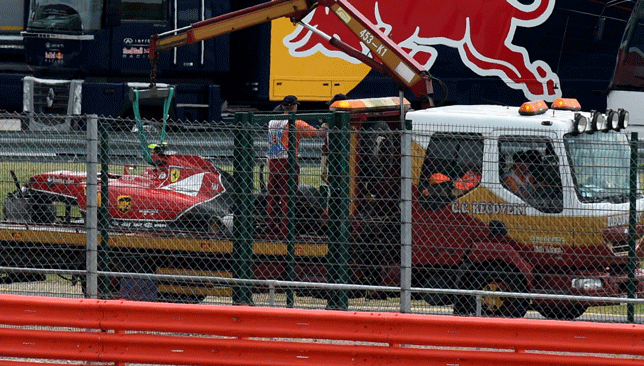
The sight of Kimi Raikkonen getting out of his Ferrari cockpit and leaning on a marshal for support was a welcome relief.
That is not to delight in the Finn’s injuries but the fact he escaped with just a damaged knee and ankle, neither of which were broken, was remarkable, and similarly that the worst that will happen is he may be hobbling for the next few days.
Watch footage of his first-lap crash and it’s easy to see how much worse that could have been.
Raikkonen, who had started 18th on the grid after a torrid Saturday qualifying session by Ferrari, ran wide at turn five and tried to scythe his way back on to the track.
On his return, however, he hit a raised edge and, at high speed, completely lost control of his car and was promptly sent sideways, catapulting across a cavalcade of cars to the other side of the track.
In the ensuing moments, he smashed into the safety barrier on Wellington Straight head first before spinning wildly out of control back onto the race track.
Amid it, Kamui Kobayashi swerved to the left of the Ferrari while Felipe Massa turned at right angles to avoid what could have been an infinitely nastier outcome.
It showed the inherent dangers that remain of open cockpit racing but also acted, in the few seconds of the accident unfolding, as a showcase for the manner in which F1 safety has progressed since 1994.
Twenty years ago, F1 endured one of its darkest weekends as Roland Ratzenberger died during qualifying for the San Marino Grand Prix and Ayrton Senna lost his life during the race itself the following day.
From the moment of Senna’s death, the FIA worked under the guidance of chief medical delegate Sid Watkins to cut the likelihood of further driver deaths.
The more instant changes included perforated airboxes to reduce power while something as simple as a wooden plank was fitted beneath the heart of the chassis to reduce downforce, all aimed at cutting speed and hence improving driver safety.
In the weeks and months that followed, crash tests became increasingly stricter, cockpits were enlarged while wheels were attached to the chassis by tethers to stop them flying off in high-speed accidents.
In the 21st Century, more and more changes have come into place.
The roll-over bar has steadily been raised above the drivers’ head and a rule put in place that it had to be able to withstand a lateral force of six tonnes.
In addition, certain circuits were redesigned, the HANS device (basically what looks like a neck brace the drivers wear) was introduced while kevlar coating became more commonplace throughout the chassis thus ensuring a greater layer of protection for the drivers behind the wheel.
That list merely scratches the surface of the things done to improve safety at every Grand Prix weekend at every circuit of every season.
Much of the thanks for that goes to the setting up of the FIA Expert Advisory Safety Committee in the wake of the Senna-Ratzenberger deaths with Watkins at its helm.
By 2004, it became the FIA Institute for Motor Sport Safety, and there has not been an F1 driver death in those 20 intervening years since the dark days of Imola.
Watkins may sadly have passed away in 2012 but the work continues without him, and information will be pored over in the wake of the Raikkonen crash to dissect what else could have been further improved in safety terms.
One notable aspect was that one of his wheels broke loose and apparently landed on the head of Max Chilton, who thankfully was unhurt.
The FIA has worked closely with the teams to ensure that doesn’t happen including, as mentioned before, strong tetherings holding the wheels in place to try and ensure they do not fly off in an impact, one of the remaining big dangers of open-cockpit racing.
The fact is F1 will never become 100 per cent safe.
If it did, some would argue what would be the point, that perhaps F1 had become too sterile.
But that is beside the point – the sight of Raikkonen moving, albeit limping, should warrant praise for the FIA and the steps that have been taken to make F1 the relatively safe sport it is today.