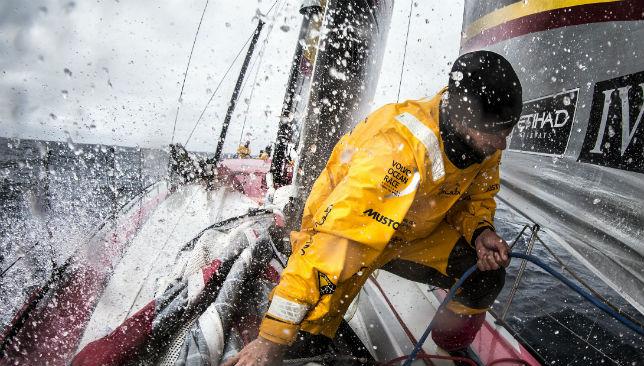
There was a subtle yet keenly palpable extra layer of tension in the early morning air in Auckland, New Zealand as the six Volvo Ocean Race crews quietly climbed aboard their brightly coloured and identically built carbon racing yachts before the start of the fifth leg to Brazil.
Although in many ways this was a familiar routine for the crews who had already raced halfway around the world since leaving Alicante, Spain almost five months ago, everyone on the dock instinctively knew that this time it was different – different because this time they were taking on one of the world’s most remote and least hospitable regions: the wild and stormy expanses of the Southern Ocean.
Despite the Southern Ocean’s fearsome reputation for gigantic waves, hurricane force winds and the lurking threat of icebergs, it nevertheless has an overwhelming lure for ocean racers. Part rite-of-passage, part personal Everest, for VOR veterans and rookies alike, crossing the Southern Ocean is the reason they sign up in the first place and the powerful magnet that draws them back time after time.

“Leg 5 is the ‘big leg’, the Southern Ocean leg, the one everyone thinks about when they talk about the Volvo Ocean Race,” says Abu Dhabi Ocean Racing navigator Simon Fisher. “We are going to see strong winds and hard conditions. It’s going to be cold and it’s going to be wet. Fast sailing and lots of excitement.”
For under-30 bowman and helmsman Luke Parkinson, this will be his first experience of the Southern Ocean, and he’s made sure to do his homework. “It’s going to be very different to what we have seen so far,” said the rookie. “Looking at the weather charts there are some new colours in the wind models – wind strengths we haven’t seen so far in this race.”
Parkinson’s fellow bowman, Justin Slattery, however is a veteran of four previous VORs, and has tackled this part of Leg 5 before. “Very big wind, very big waves and very big weather,” says the Irishman. “It’s a part of the world that can really bite you and can tear you apart.”
Abu Dhabi Ocean Racing skipper Ian Walker is even more blunt. “Anyone who says they look forward to the Southern Ocean is lying,” says the British double Olympic silver medallist from on board Abu Dhabi’s yacht Azzam on the second day of the leg. “Sailing through here is complex and sometimes it’s as much about surviving – avoiding any ice and big storms – as it is about racing.”

This is Walker’s third venture into the deep-south – his second with Abu Dhabi – and he knows better than most just how brutal the leg can be and how far from help the sailors find themselves.
“In the last race the boat started to break up and we had to capsize it and drill holes in the bottom to bolt it back together,” Walker remembers. “While that was going on we were about 100 miles from what they call Point Nemo, the furthest point on Earth from dry land. The nearest ship was more than a thousand miles away. That’s when you realise how completely alone you are down there and that your best chance of rescue is probably one of your competitors.”
Walker’s crew weren’t the only ones to find their yacht breaking up underneath them from the sustained battering dished out by the Southern Ocean waves and wind. As they nursed their stricken vessel gingerly along in search of a safe haven on the Chilean coast, five hundreds miles to the south Chris Nicholson’s Emirates Team New Zealand crew on CAMPER were limping slowly in the same direction as they worked around the clock to shore up badly broken support struts in their yacht’s bow.
It was touch-and-go for more than 24-hours with both teams monitored and tracked closely by the maritime emergency services in case a rescue mission needed to be mounted. Happily though, both crews eventually made it to Chile’s Puerto Montt. The CAMPER crew eventually managed to round Cape Horn and finish the leg to Itajaí while the ADOR yacht had to be shipped there via the Panama Canal.
That wasn’t an end to the drama and damage either. Race leaders at the time Team Telefónica were forced to stop in Ushuaia, Argentina to affect repairs to their bow and drop off a crewman who had injured his back after being washed off his feet by a monster wave. Then, when leg leaders Groupama Sailing Team were within 1,000 miles of the finish and probably feeling like they were all but home-and-dry, the hammering the French team’s mast had suffered in the Southern Ocean took its toll as it suddenly folded into three pieces.
Even the eventual leg winner, PUMA – the only yacht not to sustain structural damage – did not come out of the Southern Ocean unscathed, with nasty injuries to two crew members putting them out of action and confining them to their bunks for most of the leg. Asked afterwards how his yacht had survived so well, PUMA skipper Ken Read answered tersely: “Pure luck”.
“There were so many times when we took off from the front of waves like we were on a ski ramp,” Read explained. “The boat feels like it’s completely out of the water and how you are going to land – gently in a ball of spray or bone jarringly slammed down like hitting concrete – is something you simply have no control over. You just have get it wrong once, break the boat, and your leg is over in that instant.”
After the demolition derby of Leg 5 in the last edition, this time the VOR crews are racing identically designed yachts supposedly built strong enough to survive whatever the Southern Ocean can throw at them. Whether that turns out to be the case remains to be seen. So far in this edition the margin between success and failure has been wafer thin and we can expect the crews to be racing flat out for fear of losing miles when the six-hourly position report comes in.
“It’s that constant pressure to go faster that makes it as hard as it is,” explained Walker. “No boat is unbreakable and although there may be times when you feel you should ease back, in reality you don’t because you’re scared of losing miles you might not be able to get back.”

ADOR boat captain Daryl Wislang – a member of the CAMPER crew in the last race – added: “It’s a fine balance between pushing too hard and easing off so far you get dropped off the pack. You have to remember that you are not going to win the Volvo Ocean Race by winning this leg, but you could lose it.”
“The goal is to survive the Southern Ocean section and round Cape Horn with the yacht in good shape so that you can sail the final section at 100 per cent,” said helmsman and trimmer Phil Harmer who was aboard Groupama in the 2011-12 race.
Since leaving Auckland this time, the fleet had 24 hours of light upwind sailing before they accelerated in strong winds and big seas left behind in the wake of Tropical Cyclone Pam.
With the yachts charging over some waves and through others at speeds above 20 knots, life on deck has been a constant deluge and down below the corkscrew roller-coaster motion put paid to chances of eating or sleeping. According to Walker, the forecast is for more of the same over the next week at least as the boats hurtle towards the race-imposed virtual ice gates put in place by the race organisers.
“Right now we are expecting 30 knots winds and not too much in the 40s,” Walker reported from third-placed Azzam between stints at the wheel. “Of course, it can change fast down here so we are not counting any chickens yet as we know at some stage we will be facing big storms for sure. It’s already chilly but much worse is of course to come. We are wearing three layers, plus hats and gloves already – so not looking forward to being another 10 degrees south.”